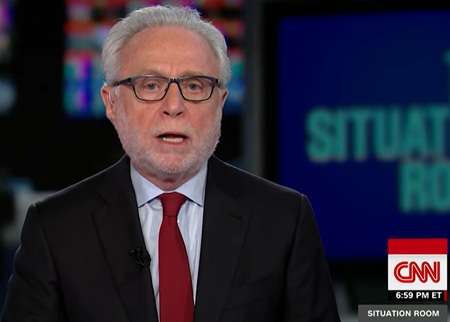
Wolf Blitzer sat across from Virginia Governor Abigail Spanberger last Friday and let her tell CNN's audience that President Trump's executive order on mail-in ballots would prevent U.S. military members and overseas voters from casting their ballots. Blitzer didn't push back. Didn't ask a follow-up. Didn't check the law. He just nodded along while a Democratic governor weaponized the troops for a political talking point.
One week later, Blitzer read a correction on air. He called it a "clarification."
Here's what Blitzer actually said on his follow-up: "A quick note of clarification. On Friday, I interviewed the Democratic Governor of Virginia, Abigail Spanberger. We discussed legal challenges to the Trump administration's directives for the Postal Service on mail-in voting. A comment I made suggested that U.S. military and overseas voters' ballots would be impacted by these directives. I want to be clear right now: those ballots are exempt from the Postal Service's new rules implementing the president's March executive order."
Exempt. Fully exempt. Under the Uniformed and Overseas Absentee Voting Act — a federal law that has protected military and overseas voting for decades — service members' ballots are completely untouched by anything the Postal Service is doing with mail-in ballot procedures. That's not a gray area. It's not a matter of interpretation. It's right there in the statute.
But Spanberger didn't mention it. And Blitzer didn't care to push back or argue with Spanberger to let viewers know the truth in real time. They only issued the correction after the full segment aired.
Blitzer even tacked on the legal specifics at the end — "Those groups are covered under the Uniformed and Overseas Absentee Voting Act, just to be specific on that point" — as if being specific was something that had occurred to him at any point during the original interview.
Spanberger hasn't corrected her own statement either. No follow-up press release. No tweet. No clarification of her own. She got what she needed: a week of voters believing that Trump was trying to take the vote away from soldiers deployed overseas. The fact that it was completely false doesn't require a retraction when you're a Democrat with a compliant press corps.
And that's the formula. It's not new. It's not even creative. Air it loud on a weeknight. Correct it quietly on a weekend. The original claim reaches ten million people. The correction reaches ten thousand. Everyone involved knows exactly how it works, and nobody on that side of the aisle has any incentive to change it.
The Uniformed and Overseas Absentee Voting Act exists precisely because we decided, as a country, that the people putting their lives on the line shouldn't have to worry about whether their vote counts. Spanberger — a former CIA officer who should know better — decided those same people were more useful as political props than as protected voters.
Blitzer called it a clarification. The rest of us have a shorter word for it.