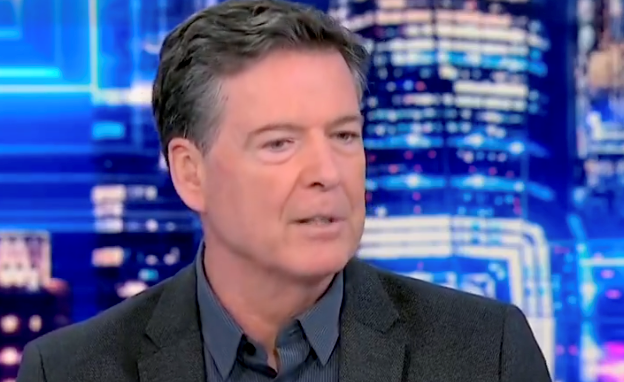
Seven days. That's how long it took the FBI to open a full counterintelligence investigation against the President of the United States after he fired James Comey on May 9, 2017. By May 16, the Bureau had launched a probe codenamed "Oxferd Comma" — and the opening memo stated its purpose in black and white: to determine if "President Donald J. Trump may be or has been, wittingly or unwittingly, involved in activities for or on behalf of the Government of the Russian Federation."
The firing of an FBI director — something any president has the constitutional authority to do — was treated as evidence of treason.
The newly disclosed documents reveal what the FBI's own paperwork said at the time. The opening electronic communication declared the investigation would "seek to determine whether President Trump and others yet to be named obstructed and/or conspiracy to obstruct any associated FBI investigation." The probe was flagged internally as a "sensitive investigative matter" — Bureau-speak for "this could blow up in our faces."
FBI General Counsel James Baker and Assistant Director for Counterintelligence William Priestap were involved in the launch. Andrew McCabe, freshly installed as Acting FBI Director after Comey's termination, oversaw the effort. Deputy Attorney General Rod Rosenstein appointed Special Counsel Robert Mueller shortly after. The probe ran for nearly two years before it was closed on April 9, 2019 — without a single charge against Trump.
The justification in the Oxferd Comma memo is worth reading twice. It argued that Trump's decision to fire Comey "can be reasonably read to imply that the FBI's counterintelligence investigation was a factor in President Trump's decision to terminate Comey." In other words, the FBI decided why the president fired Comey, then used their own theory as the basis to investigate him. Circular reasoning dressed up in legal formatting.
The agents doing the actual investigating weren't buying it. Three days after the probe opened, on May 19, 2017, FBI Deputy Assistant Director Pete Strzok texted FBI lawyer Lisa Page: "I hesitate in part because of my gut sense and concern there's no big there there." Special Agent William Barnett, who worked the case, was even more blunt. An FBI interview summary stated that "BARNETT still did not see any evidence of collusion between the TRUMP Campaign and the Russian Government." Barnett and his colleagues turned the whole investigation into a joke they called "Collusion Clue" — a hypothetical board game where "investigators are able to choose any character conducting any activity, in any location, and pair this individual with another character and interpret it as evidence of collusion."
The backdrop makes it worse. We now know — thanks to Special Counsel John Durham's 2023 report, released by the Biden Justice Department — that the entire Crossfire Hurricane investigation had no legitimate basis to begin. The Steele dossier that fueled the surveillance of Trump campaign advisers Carter Page and George Papadopoulos was financed by Hillary Clinton's campaign law firm. The FBI eventually concluded that most of Steele's claims were "provably false, internet rumors, or uncorroborated." His primary subsource, Igor Danchenko, was identified as a suspected Russian asset. And declassified notes from CIA Director John Brennan show he briefed President Barack Obama, Vice President Joe Biden, FBI Director Comey, and DNI James Clapper on August 3, 2016, about intelligence indicating Clinton had approved "a proposal from one of her foreign policy advisers to vilify Donald Trump by stirring up a scandal claiming interference by the Russian security service."
The FBI knew the collusion narrative originated as a Clinton campaign operation. They opened a counterintelligence probe against the president anyway.
The pattern extends beyond Oxferd Comma. On January 4, 2017, the FBI closed its investigation into National Security Adviser Mike Flynn after finding "no derogatory information." Then Priestap's own handwritten notes surfaced asking the quiet part out loud: "What's our goal? Truth/Admission or to get him to lie, so we can prosecute him or get him fired?" They reopened the case and prosecuted Flynn for a process crime.
Federal prosecutors in Fort Pierce, Florida are now reportedly investigating potential FBI and DOJ conspiracy related to these actions. The DOJ Inspector General already concluded that Comey "violated long-standing department practice and protocol" in his handling of the Clinton email investigation — the very performance issue Trump cited when he fired him.
So the president fired an FBI director for documented misconduct. The FBI responded by opening a secret investigation accusing the president of being a Russian agent. The investigation found nothing. The dossier that started it all was campaign opposition research. And the agents running the case were literally making board games out of how absurd it was.
That's not law enforcement. That's a bureaucracy defending its own power and daring you to call it what it is.