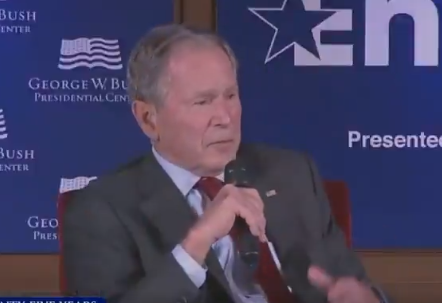
Twenty-five years ago today, 2,977 Americans were murdered by Islamic terrorists who hijacked four commercial airplanes and turned them into weapons. The Pentagon burned. The Twin Towers fell. A field in Shanksville, Pennsylvania became a graveyard. And on the 25th anniversary of all of that, George W. Bush sat down at a memorial event and talked about how great he was to Muslims.
Not the victims. Not the firefighters who ran up the stairs. Him.
The former president appeared alongside former Secretary of State Condoleezza Rice at a 9/11 anniversary event where the two reminisced about their post-attack priorities. Rice explained that the administration focused on "trying to make sure our Muslim citizens knew we didn't blame them for what had happened."
Bush went further. "I also made it clear that Islam was a religion of peace and not a religion of war and that these people subverted their religion," he said — recycling the same line he first delivered six days after the attacks in September 2001.
Six days. Three thousand bodies hadn't been recovered yet, and the president of the United States was already workshopping the PR angle for the ideology that produced the attackers.
Now look, nobody was asking Bush to demonize ordinary American Muslims. That was never the question. The question is what you choose to say when you're given the microphone on the 25th anniversary of the worst terrorist attack in American history — and his answer was a retrospective on his own sensitivity.
That's the whole Bush legacy in one clip. Two decades of failed regime change in Afghanistan. A Middle East more unstable than he found it. An intelligence apparatus that metastasized into the surveillance state we're still fighting today. And his takeaway from all of it is that he was polite.
This is exactly why the Republican base moved on. We watched an entire generation of GOP leadership treat the War on Terror as an exercise in managing optics rather than winning. Bush didn't just say "religion of peace" once under pressure in 2001 — he's still saying it in 2026, at a memorial, on camera, like it's something to be proud of.
Rice's framing is just as revealing. The chief concern she remembers from those weeks wasn't the intelligence failure that let 19 hijackers board four planes. It wasn't the scramble to prevent a follow-up attack. It was making sure a particular demographic felt included.
The establishment Republican instinct has always been the same: when something terrible happens, the first move is to make sure nobody accuses you of being mean about it. Policy comes second. Accountability comes never.
Meanwhile, the families who lost someone that day got to watch a former president use their memorial as a character reference.
Twenty-five years. Nearly 3,000 dead. Two decades of war. And the man who launched it all wants you to remember how gracious he was about it.