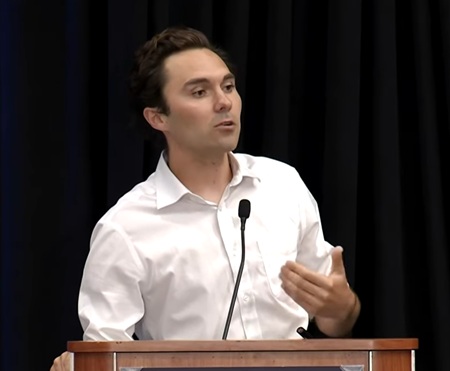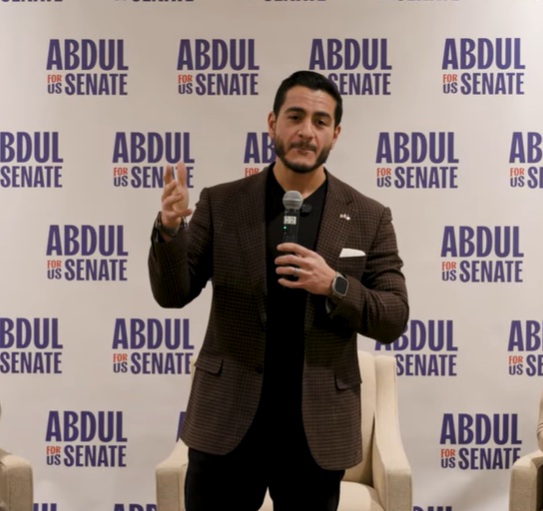
In October 2022, Abdul El-Sayed stood before the Council on American-Islamic Relations and told the audience that "you can't understand a Sharia ban without understanding the Trail of Tears." The bans on foreign and religious law that seven states have passed, starting with Oklahoma in 2010, weren't about legal sovereignty, in his telling. They were driven by the "same exact forces" behind centuries of oppression.
That man just won Michigan's Democratic Senate primary on August 4. And now Barack Obama reportedly wants to campaign for him.
El-Sayed defeated Representative Haley Stevens to claim the nomination, and he'll face former Representative Mike Rogers in the general election — a race where Rogers currently holds a 0.3-point polling advantage. Michigan is one of the tightest battleground states in the country. The seat could determine Senate control. And Democrats chose a candidate who thinks opposing Sharia law is morally equivalent to genocide.
El-Sayed's CAIR speech wasn't some off-the-cuff remark that got clipped out of context. He was making a deliberate argument that American legal efforts to keep religious law out of civil courts are rooted in the same bigotry as the forced removal of Native Americans. That's not a policy disagreement. That's a worldview.
Then there's the money. El-Sayed accepted $115,000 in donations that drew scrutiny over potential ties to organizations linked to the Muslim Brotherhood. El-Sayed's father-in-law has alleged Muslim Brotherhood ties as well. Governors Greg Abbott of Texas and Ron DeSantis of Florida both moved to designate CAIR — the organization El-Sayed addressed — as a concern in late 2025, citing its links to extremist networks.
The Department of Homeland Security has scrutinized CAIR's associations for years. None of this is hidden. It's just not mentioned on cable news when the conversation turns to Michigan's Senate race.
At an August 5 press conference, one day after his primary win, El-Sayed positioned himself as a mainstream progressive candidate. The framing was healthcare, economic populism, the usual playlist. No mention of the CAIR remarks. No mention of the donation scrutiny. No mention of radical left-wing influencer Hasan Piker, who boosted El-Sayed's campaign to his massive online following.
Which brings us to Obama. The former president reportedly considering stumping for El-Sayed tells you everything about where the Democratic Party actually is versus where it pretends to be. Obama's entire political brand is built on the idea that he's the reasonable adult in the room — the moderate voice that keeps progressives from going too far. He deploys that brand selectively, showing up only when a race is close enough to matter.
Michigan matters. And instead of steering the party toward the center in a state Trump carried, Obama is reportedly preparing to lend his credibility to a candidate who compared American law to ethnic cleansing and took six figures from donors with Brotherhood-adjacent ties.
Left-wing commentators will frame any scrutiny of El-Sayed's CAIR speech as Islamophobia. That's the predictable play. But the question isn't about El-Sayed's faith. Millions of American Muslims have zero interest in replacing civil law with religious law. The question is about a specific candidate who stood in front of a specific audience and argued that legislative efforts to prevent exactly that are acts of historical oppression. That's a policy position. It deserves a policy response, not a deflection.
Seven states passed foreign-law bans because their legislatures decided that civil courts should operate under civil law. That principle isn't controversial in any other context. Family courts in Oklahoma don't apply canon law. They don't apply Talmudic law. They don't apply Sharia. The principle is uniform — unless you're Abdul El-Sayed, in which case uniformity is just the Trail of Tears with a briefcase.
Mike Rogers has a 0.3-point edge. Michigan decided the presidency by a similarly thin margin. Obama knows exactly what he's doing — and who he's doing it for.