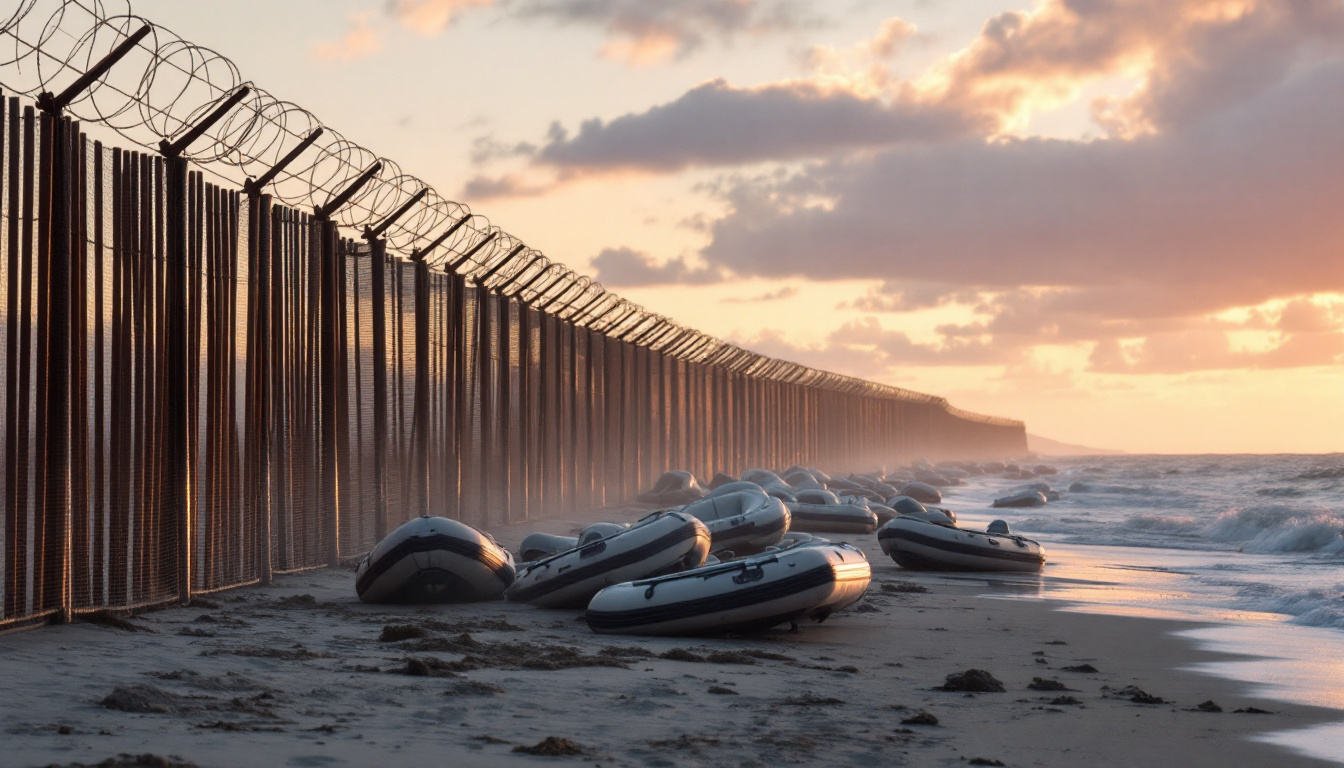
Tens of thousands of migrants stormed the border between Morocco and Spain's Ceuta enclave in a single 24-hour window. At least 18 people died — drowning in the sea, dying in stampedes at the border fence, collapsing at the breakwater at Tarajal beach. Other reports put the death toll significantly higher. Spain's regional president declared an "absolute humanitarian and social emergency" and begged Madrid to send troops.
So what did the Associated Press lead with?
"Migrant arrivals from Morocco spike."
Spike. Like a summer electricity bill or a toddler's fever.
Forbes framed it differently: "Moroccan migrant surge prompts viral right-wing backlash." Newsweek called it an "extraordinary influx." The actual footage shows people scaling fences by land and arriving on inflatable devices by sea. Bodies in the water. An overwhelmed enclave sleeping migrants on sidewalks and in parks. But the editorial instinct at three major outlets wasn't to ask how this happened — it was to scan the replies for anyone right of center who had a reaction to it.
The invasion isn't the story. Your reaction to the invasion is the story.
This didn't come from nowhere. Spain's Supreme Court ruled earlier this month that migrants intercepted at sea heading to Ceuta cannot be returned to Morocco. People-smuggling networks spotted the opening within hours. Spain's Interior Ministry responded with 60 additional troops and a promise that the Interior Minister would visit to "evaluate" the situation.
Sixty troops. To evaluate.
Prime Minister Pedro Sánchez promised to "restore order in the city and in our borders as soon as possible" and blamed the human smugglers. "They deceive so many young people," he said, "and ultimately lead many of them to their deaths."
The smugglers are part of it. The government that made the math work for them is the other part.
When Sánchez says he'll "restore order," he means something specific: enough visible action to change the headlines without changing the policy that produced the problem. His government already granted amnesty to more than one million migrants — a signal to everyone calculating whether the risk of crossing was worth it. The Supreme Court ruling stands. The networks adapt. The next wave is already forming.
Stephen Miller watched Ceuta and named what he was seeing. "Democrats did this to America every single day for 4 years under Biden," Miller posted, "and will do it again instantaneously, but orders of magnitude greater, if they are given any form of national power."
He added: "Democrats will see your home trampled and stolen by invaders and they will rejoice."
The record backs him up. Under Biden, more than 8 million migrants entered the United States between 2021 and late 2024. The same playbook: enforcement tools mothballed, legal frameworks tightened to make deportation harder than entry, and anyone who objected accused of cruelty. Ceuta is what that policy looks like at speed. America got the four-year version.
President Trump told Fox News: "That's going to be us in three years if the wrong side gets in. If the Democrats get in, you will not live a very good life."
Three years is 2028.
The AP and Forbes can see the same footage everyone else can. They made a choice. Call it a spike. Call it a surge. Point the camera at whoever's angry about it, not at whatever caused it. That framing works as long as the images can be managed. But the footage from Ceuta is everywhere — the fences, the rafts, the body count, the overwhelmed police. Spain's own government called it a crisis and sent in the military.
Europe spent decades building an immigration system where enforcing the border became legally harder than crossing it. Ceuta is what that system produces.
America's version played out over four years. Eight million people, slow enough it never produced a single image like Tarajal beach. That's the advantage of doing it gradually.
That's also why 2028 matters.