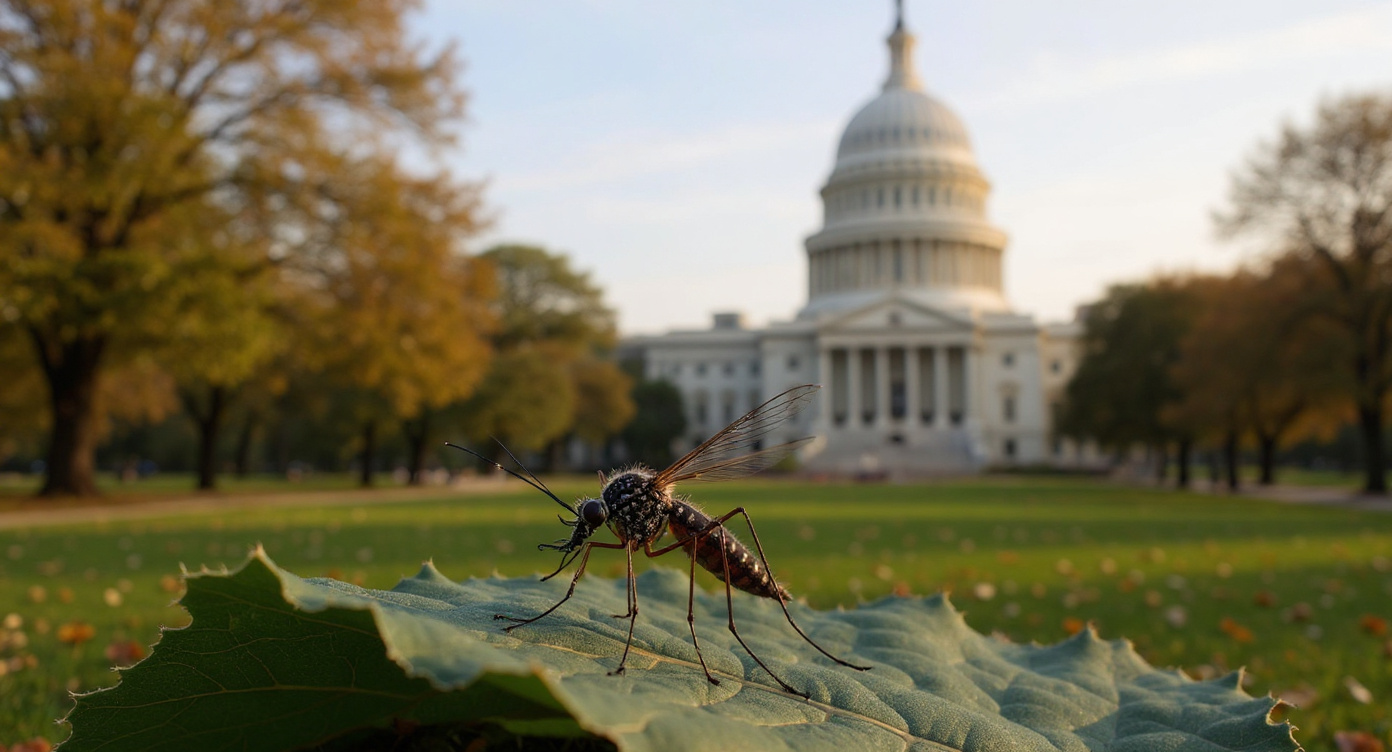
One hundred and ninety people in Florida contracted dengue fever this year — 170 of them in Hillsborough County alone, across six counties. They caught it at home, from a mosquito species that arrived in America and never left.
President Trump just signed an executive order to do something about it.
The order — officially titled "Eliminating Disease-Carrying Pests and Restoring Enjoyment of the Great Outdoors," signed September 29 — directs the Secretaries of Interior, Agriculture, and HHS, along with the EPA and GSA, to develop and implement a campaign to reduce invasive mosquito populations in Washington, D.C. by 90 percent and tick populations by 50 percent by 2028. They have 60 days to produce the plan.
The targets are specific: the Asian tiger mosquito and the Egyptian mosquito, both foreign invaders that have quietly become the dominant species in parts of the country. The diseases they carry read like a horror list: dengue fever, West Nile virus, Zika, chikungunya. On the tick side: Lyme disease, Rocky Mountain spotted fever, babesiosis, and alpha-gal syndrome — a condition where a single tick bite can leave you allergic to red meat for life.
The 90 percent target isn't aspirational. It's already been done.
A trial in Singapore using Wolbachia — a naturally occurring bacteria introduced into the mosquito population — showed Egyptian mosquito numbers fell 85 percent and dengue exposure declined 70 percent. Bee Safe Mosquito Control already released 600,000 Wolbachia-infected mosquitoes in the Washington, D.C. metro area in 2026, before this order was even signed. Google's Debug Project applied for EPA experimental pesticide approval to scale the same approach. The science works. It's been proven on another continent, and it's already running in the capital.
The order directs agencies to pursue sterilization techniques, genetic modification, beneficial bacteria, and biological controls alongside smart land management — improved drainage, rain gardens to eliminate standing water, controlling deer and rodent populations that serve as tick hosts. HHS Secretary Robert F. Kennedy Jr.'s department has already issued nearly $3 million to two CDC Centers of Excellence for vector-borne disease research. CDC Division Director Lyle Petersen described the tick initiative as "designed to move tick control forward by evaluating large-scale deployment of wildlife-targeted interventions."
Now watch what happens next. The same people who spent five years screaming "follow the science" during COVID will suddenly discover deep concerns about genetic modification and sterilization techniques when Trump is the one deploying them. The same crowd that insisted we restructure the entire global economy over climate projections will find mosquito-borne disease insufficiently alarming to warrant federal action. The objection won't be scientific — it never is. It'll be that the wrong person signed the order.
The science doesn't care who signed it. An 85 percent reduction in Egyptian mosquitoes already happened in Singapore. Six hundred thousand modified mosquitoes are already working in D.C. Google is lined up to help. The left's preferred response will be to find reasons this doesn't count, while offering nothing in its place.
The D.C. focus is quietly brilliant. Washington is federal jurisdiction — the federal government controls the territory outright, no approvals needed from governors, state legislatures, or local bureaucrats to gum up implementation. If the methods work in the capital, every city in America with an invasive mosquito problem has a proven federal model to point to.
"Ticks and mosquitoes are among the deadliest animals worldwide, transmitting major diseases that impose growing health and economic burdens," the order reads. These species weren't here a generation ago. They arrived, they spread, and the federal government's response until now has been the bureaucratic equivalent of citronella candles — pleasant-smelling and useless.
Ninety percent reduction in invasive mosquitoes. Fifty percent reduction in ticks. By 2028. With a plan due in 60 days.
That's not a press release. That's a deadline.