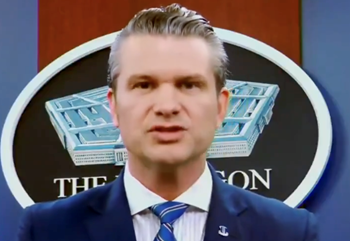
Defense Secretary Pete Hegseth is heading to Marine Corps Base Quantico later this month. But he's not there to brief the brass. He's there to talk to lance corporals and company-grade officers — the O-1 through O-3 ranks who actually carry rifles and lead fire teams.
The generals didn't get an invite.
Hegseth's planned address deliberately bypasses senior military leadership to speak directly to junior enlisted troops and company-grade officers. It's the second time Hegseth has visited Quantico — last fall, he addressed generals and admirals. This time, he's going over their heads and straight to the people who do the fighting.
The context matters. Hegseth has spent the better part of a year dismantling the Pentagon's DEI apparatus with the subtlety of a wrecking ball, and the numbers tell the story. Nearly 10 four-star officers have been fired or pushed out — from a pool of roughly 40 across the entire armed forces. At least 45 officers have been blocked from advancement. He's targeting a 20% reduction in four-star generals and admirals overall.
Among the highest-profile departures: Gen. C.Q. Brown, the Joint Chiefs Chairman, and Adm. Lisa Franchetti, the first female Chief of Naval Operations. Both fired.
"The days of divisiveness, resistance and undermining leadership are over," Hegseth has said. And he wasn't being rhetorical. DEI offices have been eliminated. Transgender service policies have been ended. Identity-based promotion criteria — gone. In their place: fitness and weight standards mandated twice yearly, with gender-neutral requirements pegged to the highest male standard.
"Standards must be uniform, gender-neutral, and high," Hegseth has stated. That sentence alone probably caused a few early retirements.
"Generals and admirals are on notice. Comply and enforce these new policies," he warned. Some complied. Some didn't. The ones who didn't are updating their LinkedIn profiles.
Chad Robicheaux, a former reconnaissance Marine and Hegseth supporter, has backed the approach as returning the military to its core mission. Amber Smith, a combat veteran and advisor to the Coalition for Military Excellence, has echoed the same — that the Pentagon had drifted so far into social programming that readiness suffered.
The usual objection writes itself: a Defense Secretary shouldn't go around his own generals. It's bad for chain of command. It undermines institutional trust. Which is a fascinating argument to make about an institution that spent the last decade running mandatory pronoun workshops while China built a navy bigger than ours. The chain of command works when the chain is pulling in the same direction. When it's not, the Secretary of Defense doesn't owe the brass a courtesy call before talking to the troops.
This is what a realignment looks like from the inside. Nearly a quarter of the four-star ranks have been cleared out. Promotion criteria now reward physical readiness and combat competence instead of checking demographic boxes. And the guy running the Pentagon is about to stand in front of a room full of Marines and explain why — not to the people who built the old system, but to the people who had to live under it.
A SecDef who talks to privates before generals is either rebuilding the military or breaking it. The troops at Quantico will probably have thoughts on which one it is.