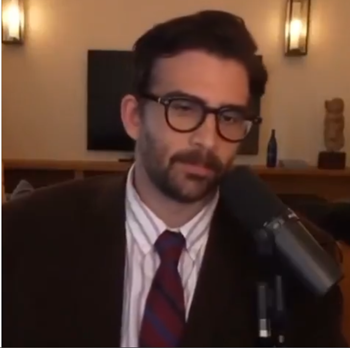
Hasan Piker went on The Axios Show this week and was asked a straightforward question: Has the United States military committed more acts of terrorism than Al Qaeda?
His answer: "Pound for pound as far as the number of deaths, yes."
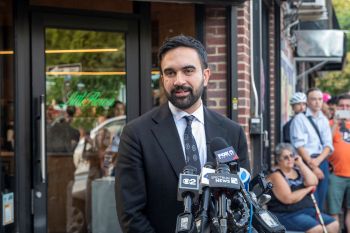
That's the man currently campaigning for Abdul El-Sayed, the Democratic candidate for U.S. Senate in Michigan. Not some anonymous internet troll. A streamer with one of the largest political audiences online, standing next to a man who wants to represent Michigan in the United States Senate, telling a national audience that the American military is a bigger terror operation than the network that murdered nearly three thousand people on September 11, 2001.
Piker didn't stop at the comparison. He told Axios the U.S. military has "caused tremendous terror all around the world," then cited an accidental missile strike on February 28 that killed schoolgirls to make his case. "If you're killing 140 schoolgirls, that is an act of terror," he said. An accidental strike during wartime and a coordinated attack on American civilians planned for months — same category, according to Piker.
He did add the caveat that "this doesn't mean that all Americans are terrorists, but the reality of the matter is we have to create an environment of accountability to ensure things like that never happen again." Generous of him.
This isn't new territory for Piker. He previously said America "deserved 9/11" — a statement he later partially walked back after the backlash got loud enough to threaten his revenue stream. The walk-back didn't include an apology. It included qualifications. And now, years later, when given the chance to cleanly separate the American military from a jihadist terror network on camera, he chose to equate them instead.
Republicans in Michigan have seized on the connection, using Piker's comments to hammer El-Sayed in the primary. The attacks write themselves. When your surrogate's public position is that the U.S. Armed Forces operate on the same moral plane as Al Qaeda, the opposition doesn't need to exaggerate. They just need to press play.
El-Sayed hasn't distanced himself from Piker. That's the detail that matters more than anything Piker said on Axios. Politicians get asked about controversial supporters constantly. The playbook is simple: thank them for their enthusiasm, disagree with the specific comment, move on. El-Sayed hasn't done that. He's kept Piker in the fold, which means either he agrees with the sentiment, or he's calculated that Piker's audience is worth more than the blowback.
Neither option plays well with the veterans, military families, and union workers who actually decide Michigan elections. These aren't people who need a Twitch streamer to explain American foreign policy to them. They buried friends. They know the difference between an accidental strike and a coordinated massacre.
The Democratic primary in Michigan is supposed to be a serious contest for a serious seat. Instead it's become a test case for how far left the party's influencer class can drag a candidate before voters notice. Piker compared the American military to Al Qaeda on national television, and the candidate he's campaigning for said nothing.
The silence from El-Sayed's campaign has been the loudest part of the story. Every day without a statement is another day the answer is on the record and unchallenged.
Piker streamed to his audience that same evening. El-Sayed's name was still in his bio.